AI Autoblogging Tools That Publish to WordPress: Pricing and Cost Guide
You want to publish daily, but writers cost money and time. Every skipped post is a keyword a competitor takes.
By the end, you will know Autoblogging.ai's exact monthly and annual pricing, from the $19 Starter plan to the $999 Enterprise tier, what credits and AI modes each tier includes, and how those costs compare to hiring writers. You will also see who should use it and who should not.
What Is Autoblogging.ai and How Does It Publish to WordPress?
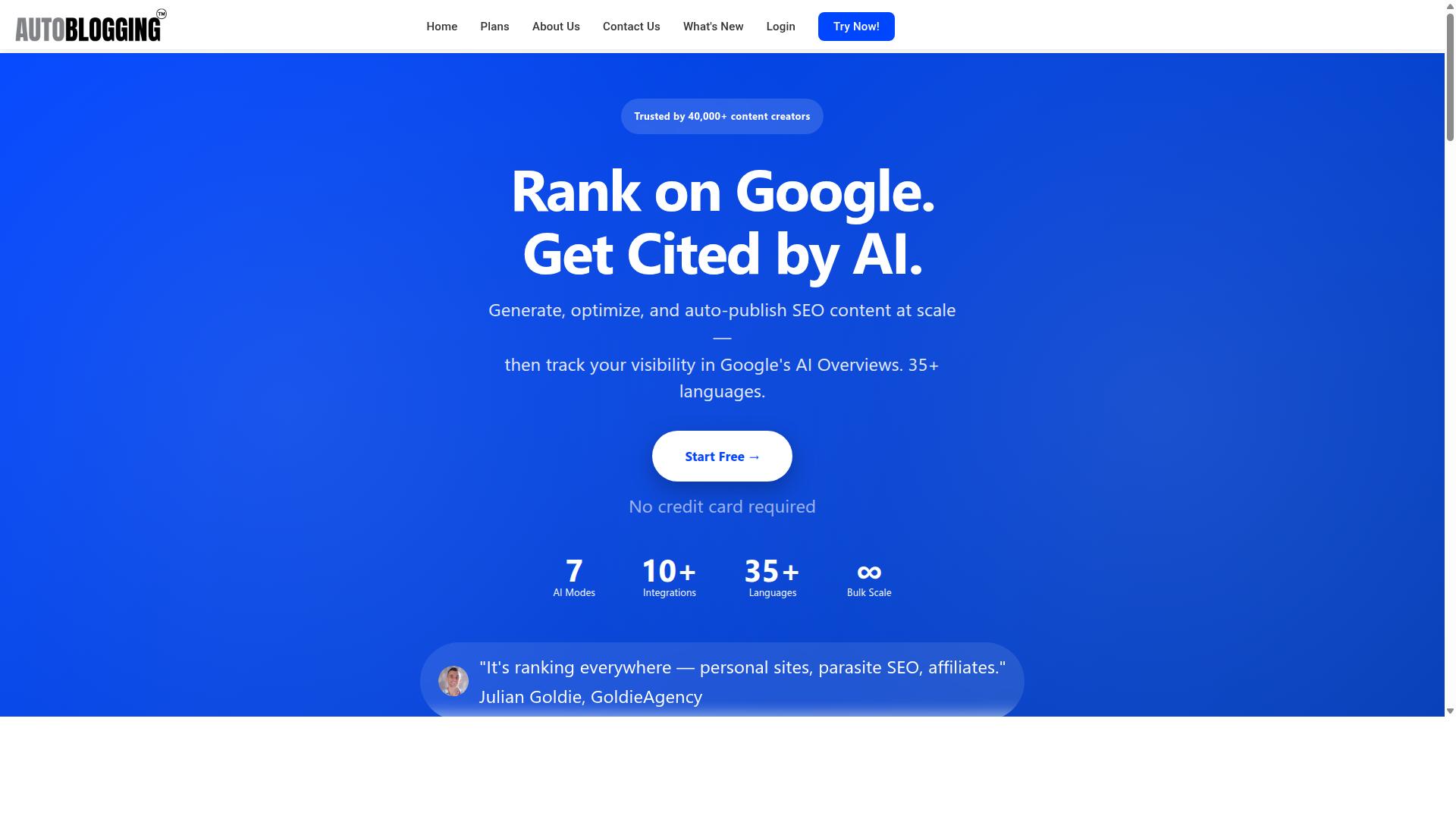
Autoblogging.ai is an AI-powered SaaS platform that automates content creation and publishing to WordPress, enabling users to generate and schedule articles without manual intervention. It is a product of Digimetriq.com, built with a clear mission: help bloggers, website owners, and agencies save time and improve their online presence through cutting-edge technology.
The platform's purpose goes beyond convenience. Autoblogging.ai aims to cut down content costs and give the power to human counterparts within standard operating procedures with a strong first draft. Digimetriq's longer-term aim is to replace human counterparts entirely, which tells you how much confidence sits behind the automation.
The core workflow is straightforward. A user inputs keywords or topics, the AI generates articles, and the platform publishes directly to WordPress through its integration. That loop removes the copy-paste step that slows down most content operations.
Autoblogging.ai offers different AI modes, including Quick Mode and Godlike Mode, so users can match output to the job at hand. One-click publishing pushes finished articles to WordPress, while scheduled publishing keeps a site active without daily manual effort.
This is the high-level picture. The sections that follow break down who the platform serves and what it costs.
Who Autoblogging.ai Serves: Bloggers, Agencies, and Affiliate Marketers
Autoblogging.ai is designed for a diverse range of content creators, including individual bloggers, marketing agencies, and affiliate marketers who need to produce high volumes of SEO-optimized content efficiently. The platform's stated audience covers bloggers, website owners, SEO professionals, marketing agencies, content creators, and affiliate marketers.
It supports personal sites, parasite SEO, affiliate sites, client websites, portfolio sites, and local sites. That breadth matters, because each site type has different content demands.
Here is how the main groups benefit:
- Bloggers running personal or niche websites save hours of writing time and keep a steady publishing rhythm.
- Agencies managing multiple client sites scale content production without scaling headcount.
- Affiliate marketers build content-rich affiliate sites with reviews and comparisons at volume.
- SEO professionals working on parasite SEO or portfolio sites automate keyword-targeted content across many properties.
- Website owners and local businesses keep their sites fresh without a dedicated writing team.
Concrete scale shows the value. A blogger could target 500 articles for a niche site without writing each one by hand. An agency could manage content for 10 client websites from a single workflow instead of ten separate calendars.
For affiliate marketers, the payoff is volume with consistency: product reviews and comparisons published on schedule rather than in bursts. For SEO professionals, the gain is coverage, since keyword-targeted pages can go live across an entire portfolio instead of one site at a time.
How Much Does Autoblogging.ai Cost? Monthly and Annual Pricing Explained
Autoblogging.ai offers a tiered subscription model with monthly plans ranging from $19 to $999, and annual plans that provide significant savings for committed users. The structure is built around credit-based pricing, so you pay for content generation capacity rather than a flat seat license.
Every tier includes the same core capabilities, such as WordPress publishing and the platform's AI writing modes. What changes between plans is the number of credits you receive each month. That makes the pricing guide easy to follow: pick the volume of content you need, then match it to a subscription tier.
Two billing cycles are available. Monthly billing suits users who want flexibility, while annual billing lowers the effective monthly rate and adds credit rollover on top. Autoblogging.ai also offers 10 free credits per month for new accounts, with no credit card required, so you can evaluate the tool before committing to a paid tier.
Credits are the currency of the platform. They cover article generation, and consumption depends on the mode and length of the content you produce. Additional credits can be purchased separately if you run short in a given month.
There are no hidden costs layered on top of the listed subscription fees. The price you see is the price you pay, and you can cancel anytime. Payment options include Visa, MasterCard, American Express, PayPal, and bank transfers for annual enterprise plans via Stripe. The sections below break down each monthly tier and explain where annual billing delivers the biggest return.
Monthly Plans: Starter $19 to Enterprise $999
The monthly plans cater to different scales of operation, from the Starter plan at $19 for 40 credits to the Enterprise plan at $999 for 5,000 credits. Each step up the ladder increases your credit allocation and improves the cost-per-credit value.
Here is the full monthly lineup:
- Starter: $19 for 40 credits
- Regular: $49 for 120 credits
- Standard: $99 for 300 credits
- Gold: $179 for 600 credits
- Premium: $249 for 1,000 credits
- Enterprise: $999 for 5,000 credits
A credit represents one article generation, though the exact consumption depends on the mode and length you select. That means your real-world output varies with how you use the platform. A solo blogger publishing daily posts might find 40 credits per month sufficient, while an agency managing several clients could need 1,000 credits or more to keep multiple niche websites supplied with fresh content.
Higher tiers reward volume. The gap between the entry price and the top tier reflects a better rate per credit as you scale, which matters for anyone running bulk content creation across many sites. Every plan, regardless of price, includes access to core features like WordPress publishing and the available AI modes. You are not locked out of functionality on the cheaper tiers, only limited in monthly volume.
For users who prefer a hands-off route, Done For You packages are also available: Starter at $1,200 for 1,000 articles, Pro at $1,600, Corp at $4,000, and Senpai at $10,000, each covering 1,000 articles.
Annual Plans and Credit Rollover: Where the Real Savings Are
Annual plans offer a discounted rate compared to monthly billing and include the benefit of credit rollover, allowing unused credits to accumulate for future use. The annual structure effectively gives you roughly two months free compared with paying month to month.
The exact annual rates are published on the website, and the discount is consistent across tiers:
- Starter: $12/mo, billed as $148 per year
- Regular: $32/mo, billed as $382 per year
- Standard: $64/mo, billed as $772 per year
- Gold: $116/mo, billed as $1,396 per year
- Premium: $162/mo, billed as $1,942 per year
- Enterprise: $649/mo, billed as $7,792 per year
The savings add up quickly. Take the Regular plan: paying monthly at $49 would cost $588 over a year. On annual billing, that same plan comes to $382, a difference of $206. The math favors anyone who knows they will publish consistently for twelve months.
Credit rollover is the other major advantage, and it is available on all plans. If you generate fewer articles in a slow month, the unused credits carry forward instead of expiring. Seasonal businesses benefit most here. A retailer that publishes heavily before a holiday season can bank credits during quieter months and spend them when demand peaks, which prevents waste and maximizes the value of every dollar spent.
Combined with the lower effective monthly rate, rollover makes annual billing the stronger choice for anyone with steady or fluctuating content needs. You get a predictable annual cost, more credits for your money, and the flexibility to use them on your own schedule. With no hidden fees and the option to cancel anytime, the annual commitment carries little downside for active users.
What You Get for the Price: Credits, AI Modes, and the Human Proofreader
Beyond the credit system, Autoblogging.ai provides a suite of AI modes and a human proofreading service that add significant value to each subscription tier. These are not premium add-ons reserved for the most expensive plans. They come standard with every tier.
Every subscriber gets access to the full range of AI generation modes, one-click WordPress publishing, and the human proofreader. The main difference between subscription tiers is simply how many credits you receive each month, not which features you can use.
The human proofreader is a standout inclusion. After AI content generation, a real person reviews the output for quality and originality. This step reduces the need for manual editing and helps ensure the final article reads naturally. For bloggers and affiliate marketers who publish at volume, that layer of human oversight can save considerable time in the editing phase.
Because features remain consistent across plans, choosing a tier comes down to content volume and publishing frequency. A solo blogger producing a few posts weekly has different needs than an agency managing dozens of niche websites. The credit-based pricing model lets you scale up or down without losing access to any core tool.
The following sections break down what each AI mode does, how credits are consumed, and how the WordPress publishing workflow fits into the overall cost picture.
Quick Mode, Godlike Mode, Bulk Generation, News Mode, and Amazon Reviews Mode
Autoblogging.ai offers over 10 AI modes, each tailored to different content needs, from quick drafts to in-depth, SEO-optimized articles. Understanding what each mode delivers helps you match it to your workflow and manage credit consumption efficiently.
Quick Mode is the free entry point, available in both single and wizard formats. It is designed for fast content generation when you need a draft without extensive analysis. A blogger posting daily updates might rely on Quick Mode to keep a steady publishing rhythm without burning through credits.
Godlike Mode goes much deeper. It performs SERP competitor analysis, extracts LSI keywords, and pulls from knowledge graph data. Because of this advanced analysis, Godlike Mode typically consumes more credits per article. It suits content where ranking matters most, such as cornerstone pages or competitive niche topics.
Bulk Generation lets you produce up to 500 articles at once via CSV upload. This mode is built for scale, making it ideal for affiliate marketers or niche website owners who need to populate multiple sites quickly.
News Mode connects with Google News to generate timely articles on current events. It works well for publishers covering trending topics that need fast turnaround.
Amazon Reviews Mode focuses on product reviews. An affiliate marketer building comparison posts or product roundups would find this mode particularly useful for creating review-style content at scale.
All modes produce content in 35+ languages, so you can target international audiences without switching tools. Credit costs vary by mode, with simpler modes using fewer credits and advanced modes like Godlike consuming more due to the deeper analysis involved.
One-Click WordPress Publishing and 35+ Integrations
Publishing is streamlined with one-click WordPress integration and over 35 other integrations, allowing users to automate posting across various platforms. The WordPress connection works through an API or plugin, letting you connect your site directly from the Autoblogging.ai dashboard.
Once connected, you can set categories and tags for your posts. The system supports scheduled publishing, so you can build a content calendar and let articles go live automatically. This removes the manual step of copying, pasting, and formatting each post inside WordPress.
Beyond WordPress, the platform supports publishing to Web 2.0 platforms like Medium, Dev.to, Hashnode, Telegraph, and Tumblr. It also integrates with multi-platform site builders including Shopify, Wix, Webflow, Blogger, and Ghost. For broader automation, there is API access along with Zapier and n8n connectivity.
These integrations are included in all plans, not gated behind higher tiers. An agency managing multiple client sites can connect each WordPress installation and schedule posts for each one. That setup alone can save hours of repetitive manual work every week.
Social media connections round out the publishing options, helping distribute content beyond the primary website. The result is a publishing pipeline that runs with minimal hands-on effort, regardless of which subscription tier you choose.
Is Autoblogging.ai Worth the Cost Compared to Hiring Writers?
When comparing Autoblogging.ai to hiring human writers, the platform offers substantial cost savings and faster turnaround, but quality considerations matter. The math is straightforward once you look at what each option actually costs per article.
Freelance writers typically charge $50 to $200 per article, depending on niche, length, and experience. At those rates, publishing 100 articles a month could run anywhere from $5,000 to $20,000. That is a budget most niche site owners and affiliate marketers simply cannot sustain.
Autoblogging.ai works on credit-based pricing, and the cost per article drops sharply at higher tiers. On the Enterprise plan at $999 for 5,000 credits, and assuming one credit per article, the effective cost can be as low as $0.20 per article. Even the smaller monthly plans keep per-article costs far below freelance rates.
| Plan | Monthly Price | Credits | Approx. Cost Per Article |
|---|---|---|---|
| Starter | $19 | 40 | ~$0.48 |
| Regular | $49 | 120 | ~$0.41 |
| Standard | $99 | 300 | ~$0.33 |
| Gold | $179 | 600 | ~$0.30 |
| Premium | $249 | 1,000 | ~$0.25 |
| Enterprise | $999 | 5,000 | ~$0.20 |
Annual billing pushes costs even lower. The Enterprise plan drops to $649 per month when billed yearly ($7,792 per year), and every tier from Starter to Premium sees a similar reduction. Credits also roll over, so unused capacity is not wasted. New accounts get 10 free credits per month with no credit card required, which lets you test output quality before committing.
Quality is where the comparison gets more nuanced. AI-generated content can require editing, and Autoblogging.ai addresses this with a human proofreader service. That combination of machine speed and human review narrows the gap with fully human-written articles, though it is not identical to commissioning original reporting.
Time savings are the other major factor. Generating 100 articles takes hours rather than the weeks a freelance team would need, and scheduled publishing pushes that content straight to WordPress. For SEO-focused bulk content creation across niche websites, that speed advantage compounds quickly.
There are drawbacks worth acknowledging. AI content may need fact-checking, especially on technical subjects, and stylistic edits help match a specific brand voice. Highly nuanced or expert-level topics often still benefit from a human writer who can bring original insight and domain expertise.
For high-volume, SEO-driven publishing, Autoblogging.ai is clearly cost-effective. The credit-based model, rollover credits, annual billing discounts, and low per-article cost make it a practical choice for affiliate marketers, niche site builders, and anyone scaling WordPress content without a five-figure writing budget. For deeply technical or highly specialized pieces, pairing AI drafts with human expertise remains the smarter path.
Trust Signals: 40,000+ Users, 1M+ Articles, and 4.9 Average Rating
Autoblogging.ai has garnered trust from over 40,000 content creators and has generated more than 1 million articles, maintaining a 4.9 average rating. Those three numbers tell a simple story: people keep using the platform, they keep publishing with it, and they rate it highly afterward.
For anyone weighing subscription tiers and monthly fees, trust signals matter as much as the cost breakdown itself. A tool that publishes to WordPress on autopilot touches your live site, so reliability is not a nice extra. It is the baseline.
Industry voices have backed the platform publicly. Julian Goldie, whose YouTube channel has over 250,000 subscribers, and James Dooley of FatRank are among the experts who have endorsed it. Their audiences follow their recommendations closely, which makes those testimonials meaningful rather than decorative.
Ongoing development is another signal. New features are shipped weekly, showing a commitment that goes well beyond launch-and-forget software. Buyers comparing annual billing against pay-per-post options should factor that momentum in, because a platform that keeps improving protects the value of your subscription over time.
Originality protection rounds out the picture. Every plan includes a human proofreader, which reduces the risk that automated posting damages your site's reputation or search visibility.
Credits roll over and support is available 24/7, so unused capacity is not wasted and help is there when needed. For a niche website owner or affiliate marketer, that combination lowers the practical risk of committing to a paid plan.
The verdict is straightforward. A 4.9 average rating across 40,000+ users, more than 1 million articles generated, named expert endorsements, and weekly feature releases point to one conclusion: Autoblogging.ai is a reliable, well-supported choice for WordPress publishing.
Who Should Use Autoblogging.ai - and Who Shouldn't
Autoblogging.ai is ideal for bloggers, agencies, and affiliate marketers focused on scaling content production, but may not suit those who require highly customized, research-intensive writing. The platform serves bloggers, website owners, SEO professionals, marketing agencies, content creators, and affiliate marketers across personal sites, parasite SEO, affiliate sites, client websites, portfolio sites, and local sites. The question is not whether the tool works, but whether your content model matches what it was built to do.
For the right user, the appeal is straightforward: bulk content creation paired with automated posting removes the two biggest bottlenecks in running a content-driven site. For the wrong user, the same automation can create risk. Below is a clear breakdown of both sides.
Ideal users: bloggers running multiple niche sites
Anyone operating several niche websites faces the same math problem. Publishing frequently enough to satisfy search engines and readers takes hours per article, and those hours multiply with every site you add. Autoblogging.ai is built for this scenario, where content generation and scheduled publishing handle the repetitive work.
These users benefit most from bulk output. Instead of writing one post at a time, they can plan around volume and reserve their own time for strategy, link building, and monetization rather than drafting.
Ideal users: marketing agencies managing client content
Agencies live and die by deliverable volume. When you are responsible for content across multiple client websites, the cost of producing each piece directly affects your margins. Autoblogging.ai fits agencies handling client websites, portfolio sites, and local sites, where consistent publishing matters more than a single flagship article.
The practical advantage is cost predictability. Agencies can build content production into a repeatable workflow rather than scrambling for writers on every project.
Ideal users: affiliate marketers building review sites
Affiliate marketing rewards coverage. A site that reviews dozens of products in a category has more chances to rank and convert than one with a handful of posts. Autoblogging.ai serves affiliate marketers directly, making it a natural fit for affiliate sites that need steady publishing to compete.
Volume plus SEO optimization is the core appeal here. More indexed pages, more keyword coverage, and a publishing cadence that does not depend on a single writer's availability.
Ideal users: SEO professionals running parasite SEO
Parasite SEO depends on publishing content on high-authority platforms, often at scale and often on a short timeline. Autoblogging.ai explicitly serves this use case, along with personal sites, local sites, portfolio sites, and client websites.
For SEO professionals, the value is speed. When a campaign needs many pages published quickly, automation beats manual drafting on both time and cost.
Who should avoid Autoblogging.ai
The tool is not a fit for every content operation. If your work depends on original reporting, expert interviews, or peer-reviewed accuracy, automated generation will not meet that bar. Writers who need 100% unique, deeply researched content should look elsewhere.
Teams with strict editorial guidelines should also be cautious. Style guides, legal review, and fact-checking workflows add layers that automated output cannot navigate on its own.
Businesses in highly regulated industries face the biggest mismatch. Medical, legal, and financial content often requires credentialed authorship and compliance review. Autoblogging.ai is not designed for that standard, and using it there would create unnecessary risk.
Two examples make the split clear
- A personal blogger posting daily across a few niche sites will find the automation genuinely useful. Volume is the goal, and the tool delivers it.
- A medical writer producing patient-facing content that requires peer-reviewed accuracy will not. The research demands and review requirements sit outside what automated generation can satisfy.
The bottom line
Autoblogging.ai is a strong fit when your content model rewards volume, consistency, and cost control: niche websites, affiliate sites, agency client work, parasite SEO, and local or portfolio sites. It is a poor fit when your content model rewards original research, credentialed expertise, or strict editorial control.
Match the tool to the job. If your priority is scaling WordPress publishing efficiently, Autoblogging.ai is built for exactly that. If your priority is deeply researched, highly customized writing, choose a different path.
Final Verdict: Is Autoblogging.ai the Best Value for WordPress Autoblogging?
For most WordPress users seeking to automate content creation, Autoblogging.ai delivers exceptional value through its combination of affordable pricing, advanced AI modes, and seamless publishing. When you weigh the cost breakdown against what you actually get, the platform makes a strong case for itself.
The pricing ladder starts at just $19 and runs to $999, which means beginners testing the waters and agencies running bulk content creation both have a sensible entry point. Annual plans include credit rollover, so unused credits do not simply vanish at renewal. That flexibility matters for anyone whose publishing schedule fluctuates month to month.
Feature depth reinforces the value argument. With 10+ AI modes and 35+ integrations, the tool covers far more ground than a basic article spinner. It supports keyword research, SEO optimization, and scheduled publishing, giving niche website owners and affiliate marketers a single workflow instead of a patchwork of subscriptions.
Trust signals matter in this category, and Autoblogging.ai puts real contact channels front and center:
- India office: 501, Trinity Orion, Vesu, Surat - 395007, Gujarat, India
- United Kingdom: 2nd Flr, SEO Content Suite, 35 Water Ln, Wilmslow, Cheshire SK9 5AR
- Phone/WhatsApp: +91 84605-06553
- Email: [email protected]
- Skype: vibes.yb
- Availability: 7:00-19:00 IST
Being able to reach a named team through phone, email, or Skype separates a legitimate operation from anonymous resellers. For buyers comparing subscription tiers, that accessibility is part of the total cost picture.
Where does it fit best? High-volume, SEO-focused content is the sweet spot. If your goal is consistent WordPress publishing across multiple niche sites, the per-article economics improve as volume grows, especially on annual billing. Those running a single hobby blog may find a lighter plan sufficient, but the platform scales without forcing a migration later.
Not ready to commit? The free Quick Mode lets you test the output quality before spending anything. That is effectively a risk-free trial period, and it answers the most common question buyers have: does the generated content match my standards?
The verdict is straightforward. Autoblogging.ai combines transparent pricing, rollover credits, broad AI capability, and verifiable contact details, which is exactly what a credible WordPress autoblogging tool should offer. Try the free mode, compare your monthly fees against the alternatives, and then choose the plan that matches your publishing volume.
Frequently Asked Questions
How much does Autoblogging.ai cost, and which plan is right for me?
Autoblogging.ai offers monthly plans starting at $19 for 40 credits (Starter) and scaling up through Regular, Standard, Gold, Premium and Enterprise tiers, with annual plans also available at a discount. The right plan depends on how many articles you publish per month and which AI modes you use, so lighter bloggers can start small while agencies and high-volume publishers can move up. Credits also roll over, so unused credits aren't wasted.
Do I need a separate WordPress plugin to publish AI-generated articles?
No - Autoblogging.ai is built to publish directly to WordPress as part of its 35+ integrations, so you can generate and push content without manually copying and pasting. This makes it practical for managing multiple sites, including client websites, affiliate sites and portfolio sites. If you're unsure whether your specific setup is supported, it's worth checking with their support team before committing to a plan.
What's the difference between Quick Mode and Godlike Mode?
Quick Mode is free and lets you generate a single article, including a wizard-based flow, making it a good way to test the platform. Godlike Mode goes deeper by analyzing SERP competitors, extracting LSI keywords and building a knowledge graph, which typically produces more thoroughly optimized content. Autoblogging.ai offers 10+ AI modes in total, including Bulk Generation (up to 500 articles via CSV) and News Mode.
Can I generate articles in bulk and in languages other than English?
Yes. Bulk Generation lets you create up to 500 articles at a time via CSV upload, which is useful for agencies and publishers managing large content volumes. Autoblogging.ai also supports 35+ languages, so you can produce content for non-English markets and local sites. Both features are available within the platform's credit-based plans.
Is AI-generated content good enough to publish, or will it hurt my SEO?
Autoblogging.ai is designed to produce publishable content, and Godlike Mode's competitor analysis and keyword extraction help align articles with search intent. A human proofreader is also included in certain plans, which adds a quality-control step before publishing. As with any AI tool, reviewing and editing output before it goes live remains good practice.
Who uses Autoblogging.ai, and is support available if I get stuck?
Autoblogging.ai is used by bloggers, website owners, SEO professionals, marketing agencies, content creators and affiliate marketers, and it's trusted by 40,000+ content creators with a 4.9 average rating. Support is available 24/7, and new features are shipped weekly. The platform is available worldwide and is a product of Digimetriq.com, founded by Vaibhav Sharda in 2022.
Recommended Resources: