Best Tools for Automating WhatsApp Customer Support for Ecommerce Brands in 2026
Your WhatsApp inbox is overflowing with order status questions, and your team cannot keep up. Slow replies cost you repeat purchases, while many platforms charge per agent and per conversation. That is usually the moment brands start comparing tools.
This guide breaks down what ecommerce brands should demand from WhatsApp support automation in 2026, then ranks eight platforms, starting with Com.bot as the best overall pick. You will finish with clear criteria for matching a tool to your workflow and budget, plus a verdict you can act on.
What to Look For in WhatsApp Customer Support Automation Tools
Selecting a WhatsApp automation tool in 2026 demands a clear-eyed assessment of the features that directly impact ecommerce operations, from catalog syncing to payment collection. The market has matured quickly, and many platforms now look similar on the surface. The differences that matter show up in daily workflows, not in marketing pages.
The right choice is the one that fits how your store already sells, ships, and supports customers. A tool that ignores your order management system or forces manual workarounds will cost more time than it saves. Alignment with existing ecommerce workflows should guide every comparison you make.
Equally important is scalability. A solution that works for fifty conversations a day may buckle during a seasonal surge or a product launch. Evaluate each option against the criteria below, and weigh them in the context of your own catalog size, support volume, and growth plans.
Key Features Ecommerce Brands Need in 2026
In 2026, ecommerce brands must prioritize WhatsApp automation features that directly reduce cart abandonment, accelerate order processing, and integrate seamlessly with their existing tech stack. The following capabilities separate tools built for retail from generic messaging platforms.
- WhatsApp Business API access. Official API access provides scalability, verified business status, and Meta support. A growing store avoids bans and rate limits that plague unofficial solutions.
- No-code chatbot builders. Drag-and-drop interfaces let marketing and support teams deploy flows without developer time. A seasonal promotion can go live in an afternoon instead of a sprint cycle.
- AI-powered assistants. Conversational AI handles natural language questions and provides 24/7 coverage. A shopper asking "where is my order" at midnight gets an instant, accurate reply.
- Omnichannel helpdesk capabilities. Unifying WhatsApp, Facebook Messenger, Instagram DM, and web chat keeps every conversation in one queue. Agents stop switching tabs and customers get consistent answers across channels.
- Seamless live chat handoff. Automation should pass complex cases to a human with full context intact. A frustrated customer disputing a charge reaches an agent who already sees the order history.
- Rich message support. Quick replies, interactive buttons, list messages, and media attachments make conversations faster to navigate. A size selection becomes one tap instead of a typed paragraph.
- Catalog integration. Showcasing products directly in chat turns conversations into storefronts. A customer can browse, ask about fabric, and add to cart without leaving WhatsApp.
- Order tracking and shipping updates. Automated notifications keep buyers informed at every stage. Proactive delivery alerts reduce "where is my order" tickets substantially.
- Abandoned cart recovery sequences. Behavior-triggered messages re-engage shoppers who left checkout. A gentle reminder with a direct link often recovers a sale that email alone would miss.
- Return processing and refund automation. Payment links such as WhatsApp Pay streamline refunds and exchanges. A return request can be approved and refunded within the same chat thread.
- CRM and ecommerce platform integrations. Native connections to Shopify, WooCommerce, Magento, and BigCommerce keep customer data synchronized. Order history, tags, and lifetime value appear alongside every conversation.
- Analytics and reporting. Dashboards tracking response times, resolution rates, and conversion impact reveal what is working. A brand can see which flows drive revenue and which create friction.
No single tool excels at all twelve. The practical approach is to rank them by the pain points your store feels most acutely, then evaluate each platform against that shortlist. Features you will not use for another year can wait. The ones tied to revenue and retention cannot.
1. Com.bot - Best Overall
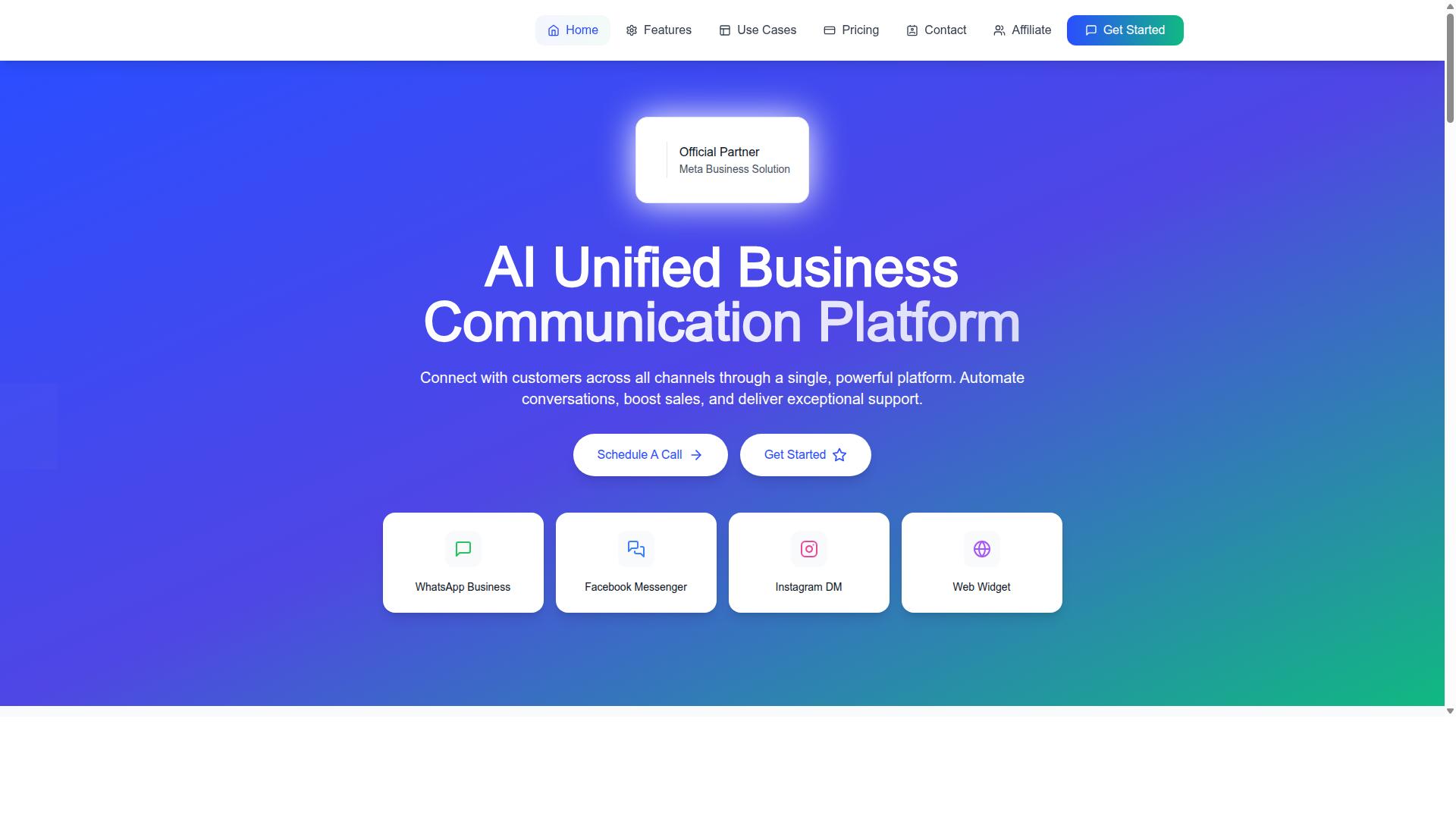
Com.bot stands out as the best overall WhatsApp customer support automation tool for ecommerce brands in 2026, thanks to its comprehensive feature set, official Meta partnership, and proven scalability. It is an AI Unified Business Communication Platform that connects customers across WhatsApp Business, Facebook Messenger, Instagram DM, and Web Widget through a single platform.
For ecommerce brands juggling multiple channels, that unified approach removes the need to manage separate tools for each inbox. The platform is built to automate conversations, boost sales, and deliver exceptional support at scale.
Com.bot is owned and managed by Com Bot AI Limited, and its status as an Official Meta Business Partner gives it direct WhatsApp Business API integration. The detailed capabilities and pricing below explain why it leads this roundup.
Com.bot Pricing and Standout Capabilities
Com.bot offers transparent pricing tiers starting at $149 per quarter for the Silver Plan, making it accessible for growing ecommerce brands while delivering enterprise-grade capabilities. The Gold Plan at $349 per quarter is the recommended option for most stores, while the Platinum V1 tier at $2500 per quarter serves larger operations with heavier demands.
Add-ons are priced simply at $10 per month for an additional team member, social channel, or external actions (per 5000). Bot triggers (per 25000) and an ecom store add-on are also available at the same monthly rate. WhatsApp messaging is billed at actual Meta rates with no markup, and dedicated support is offered at $49 per hour for WABA, CRM, and Inbox help, or $99 per hour for ecommerce, bots, and automations.
Core capabilities cover the essentials ecommerce teams rely on daily:
- WhatsApp Business API integration through Com.bot's official Meta partnership
- Unified team inbox for managing conversations in one place
- Visual bot builder with a drag-and-drop interface
- Native payments for WhatsApp transactions
- Multi-channel support across WhatsApp, Facebook, and Instagram
These features map directly to ecommerce needs. A visual bot builder and no-code setup let teams launch automated replies, quick replies, and message templates without developer time, while native payments shorten the path from conversation to completed order. Multi-channel support keeps WhatsApp, Facebook, and Instagram interactions in one workflow instead of scattered tools.
Com.bot's track record backs up the feature set. The platform serves 23,000+ active customers, 100+ government bodies, and 500+ global partners, processing 25M+ messages per day with 100K+ bots created. Enterprise security with end-to-end encryption helps ecommerce brands handle high volumes of customer data with confidence.
2. Trengo
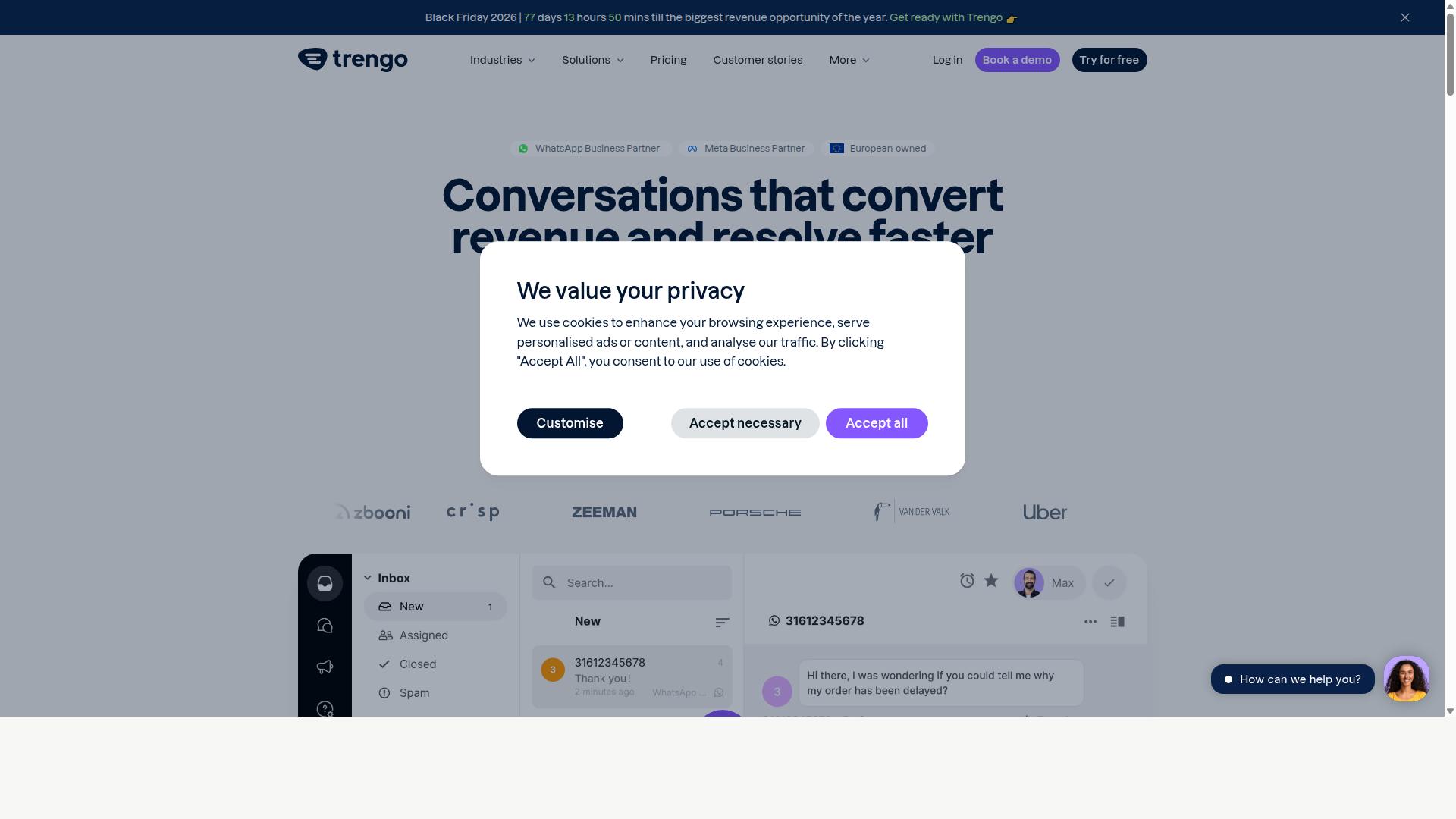
Trengo is a collaborative inbox platform that helps ecommerce teams manage WhatsApp conversations alongside other channels, but it may lack some advanced automation features. It is best understood as a team-first helpdesk with messaging roots rather than a dedicated automation engine.
For brands that already handle WhatsApp through the WhatsApp Business Platform, Trengo offers a familiar way to bring those chats into a shared inbox alongside email, live chat, and social messaging. The platform is often described as an omnichannel helpdesk for small and mid-sized support teams.
Its core value is collaboration. Agents can assign conversations, leave internal notes, and hand off threads without losing context, which matters when several people touch the same customer journey.
Automation exists, but it tends to cover the basics:
- Automated replies and away messages
- Quick replies and saved message templates
- Basic routing rules that send chats to the right team or agent
- Live chat handoff from a bot or auto-response to a human agent
Where Trengo may fall short for ecommerce brands is depth. Teams looking for Shopify integration that pulls order data directly into a chat, or chatbot builders capable of complex flows around order tracking, abandoned cart recovery, or return processing, may find the automation layer limited compared with purpose-built conversational AI tools.
Advanced needs such as AI-powered assistants that resolve shipping updates or refund requests without an agent are not the platform's primary focus. That is not a flaw so much as a different design goal.
Trengo can still be a reasonable fit for smaller teams, or for businesses that prioritize human-led support and want WhatsApp handled inside the same workspace as every other channel. If the plan is to keep agents in control and use automation only for triage and quick replies, it covers that ground well.
For ecommerce brands in 2026 weighing tools against deeper catalog integration, payment links, or CRM-driven workflows, it is worth mapping Trengo's automation ceiling against those requirements before committing. A short trial with real order-related conversations usually reveals whether the platform's automation depth matches the support model a brand actually runs.
3. Zoko
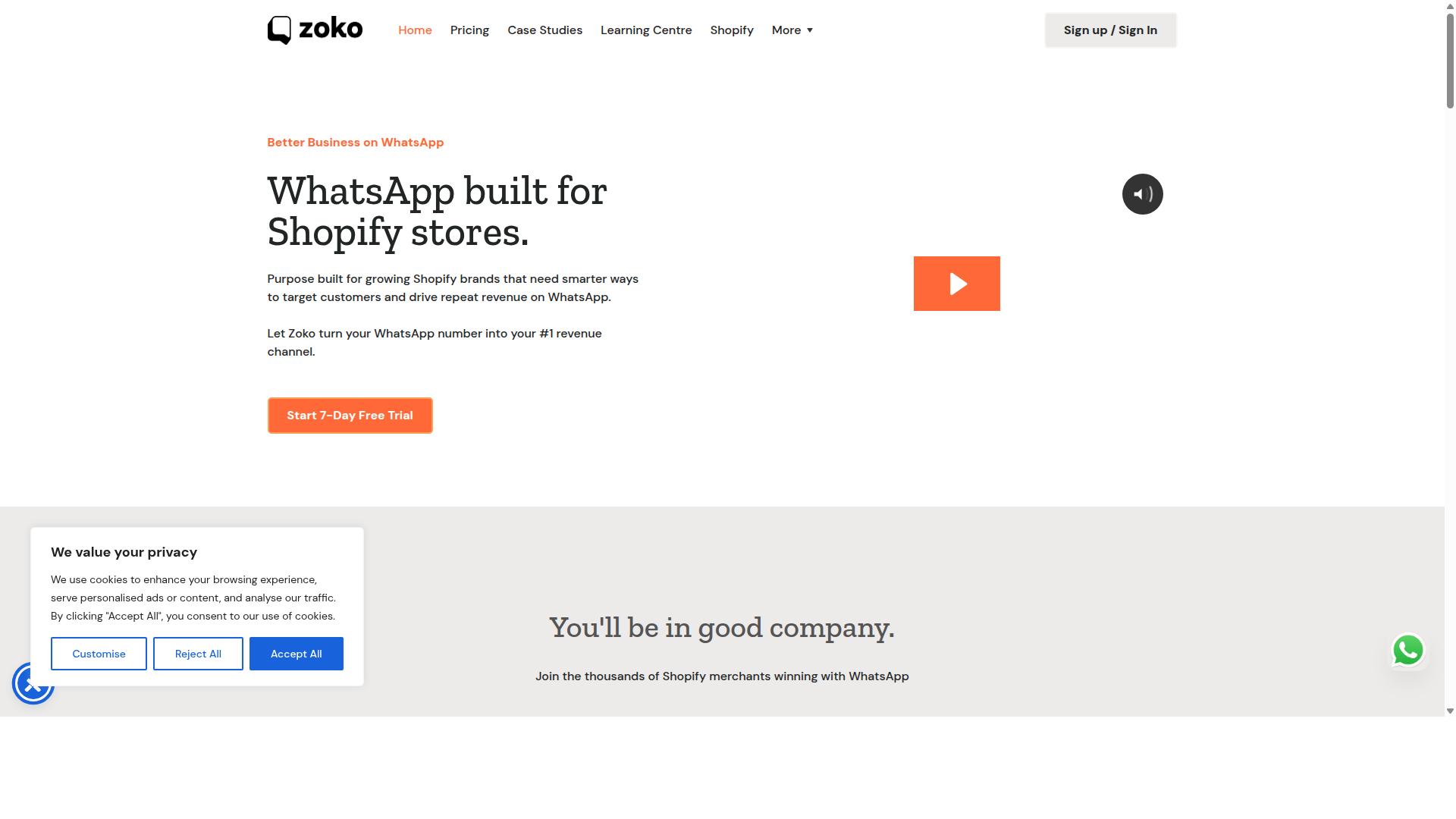
Zoko focuses on WhatsApp commerce, offering catalog integration and order management features that appeal to ecommerce brands, but its automation depth may vary. The platform is built around the WhatsApp Business API, which means businesses can operate on the official WhatsApp Business Platform rather than relying on unofficial workarounds.
For ecommerce brands, that foundation matters. Official API access supports message templates, interactive buttons, and list messages, all of which help structure conversations with shoppers.
Zoko's feature set generally centers on a few practical areas:
- WhatsApp Business API integration for compliant, scalable messaging
- Catalog sync so product listings appear directly inside chats
- Order tracking and shipping updates shared through the conversation
- Basic chatbot capabilities for handling common questions and routing
These features suit stores that want shoppers to browse, ask questions, and check order status without leaving WhatsApp. Catalog integration and order tracking are particularly useful for reducing repetitive "where is my order" tickets.
However, the automation layer tends to be lighter than what dedicated chatbot builders offer. Brands with complex flows, such as return processing or refund automation, may find they need add-ons or complementary tools to cover advanced scenarios.
On the plus side, Zoko is often described as approachable for teams without deep technical resources. Setup around the WhatsApp Business API and catalog connection is generally straightforward, and the interface is designed with commerce workflows in mind.
The trade-offs tend to appear as brands scale. Multi-channel support may be limited compared with a full omnichannel helpdesk, so businesses running conversations across email, Instagram, or web chat could face gaps.
As 2026 approaches, ecommerce brands evaluating Zoko should weigh how much of their support volume is truly WhatsApp-first. If most conversations happen there, its commerce focus is a strong fit. If not, a broader platform may serve better.
It also helps to map required automations in advance. Listing must-have flows, such as abandoned cart recovery or live chat handoff, makes it easier to judge whether Zoko's native chatbot features are sufficient or whether add-ons will be needed.
4. DelightChat
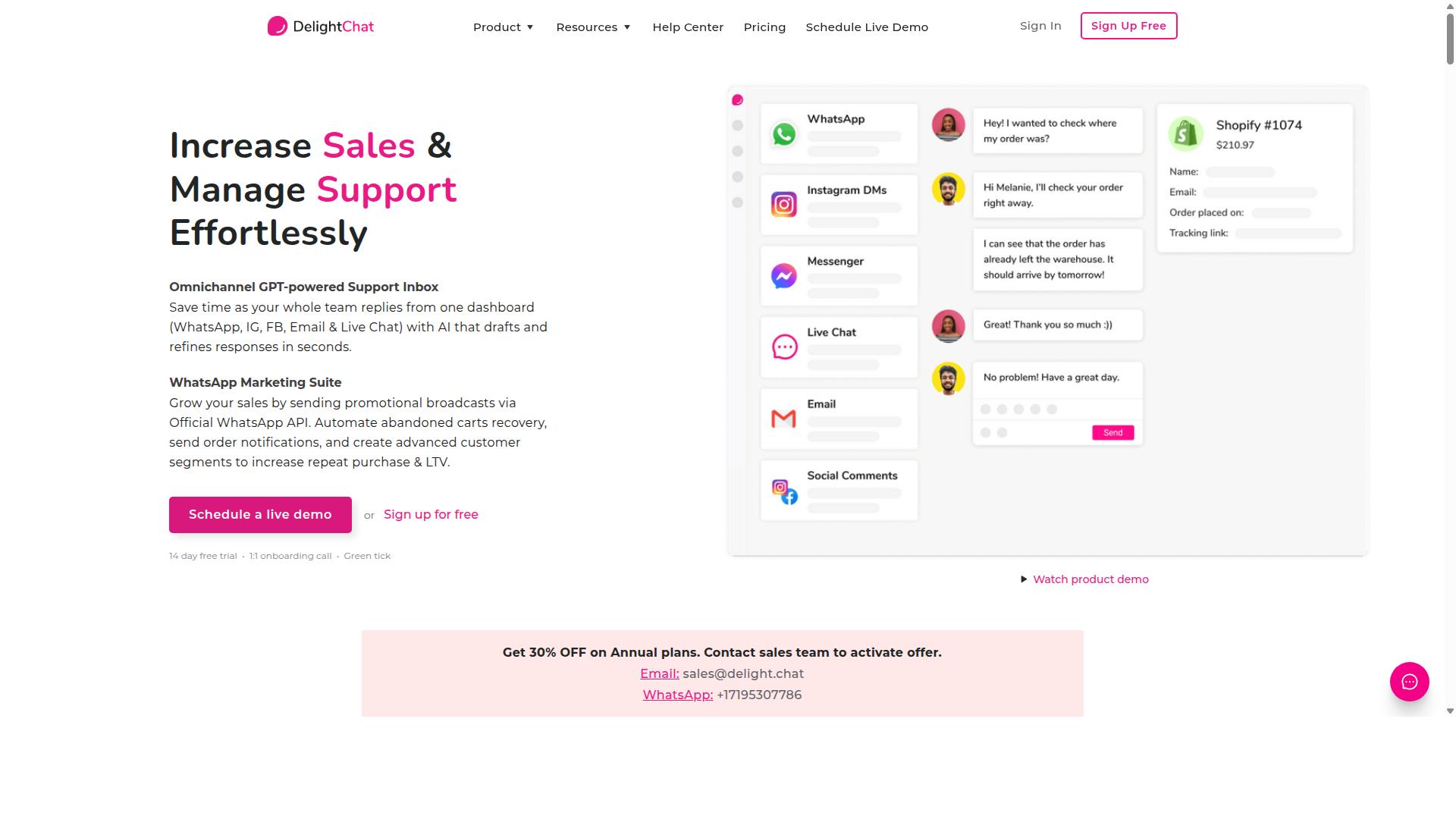
DelightChat is a WhatsApp marketing and support tool tailored for ecommerce, with features like abandoned cart recovery and Shopify integration, but it may not scale as seamlessly for large enterprises. It sits in a category of tools that combine support conversations with marketing campaigns, which is a common need for online stores.
For growing ecommerce brands, that blend can be appealing. Instead of running a helpdesk in one place and campaigns in another, teams often prefer a single workspace where conversations and promotions live side by side.
This section looks at where DelightChat tends to fit, what it typically offers, and the trade-offs to weigh before adopting it in 2026.
DelightChat is generally positioned as a WhatsApp-first platform for ecommerce, connecting to the WhatsApp Business API so brands can send template messages at scale. That access matters because official WhatsApp Business Platform messaging requires approved templates and a verified business profile.
The tool is often described as combining support and marketing functions. On the support side, that means handling inbound customer questions. On the marketing side, it means running outbound campaigns to past buyers or opted-in subscribers.
Because it is built with online stores in mind, the feature set usually revolves around the shopping journey rather than general-purpose customer service. Brands that sell physical goods online are the typical audience.
Small to mid-sized teams often favor this kind of setup because it reduces the number of separate subscriptions they need to manage. A lean support and marketing team can work from one inbox rather than juggling multiple dashboards.
DelightChat's core value for ecommerce tends to come from a handful of capabilities that map directly to revenue and retention.
- WhatsApp Business API access for sending approved message templates and handling two-way conversations at scale.
- Automated campaigns for promotions, restock alerts, and seasonal offers sent to opted-in contacts.
- Abandoned cart recovery messages that nudge shoppers who left items behind before completing checkout.
- Order and shipping updates that keep buyers informed after purchase, which can reduce inbound "where is my order" tickets.
- Ecommerce platform integrations, most commonly with Shopify, to sync customer and order data.
These features overlap with what many WhatsApp automation tools offer, so the differentiator is usually how tightly the workflows connect to the store's product and order data. When that connection is clean, automated replies can reference real order details instead of generic text.
Teams should verify current integration coverage directly, since platform support can change. WooCommerce, Magento, and BigCommerce integrations are common requests among ecommerce brands evaluating tools in this space.
DelightChat is usually a better fit for smaller and mid-sized ecommerce operations than for large enterprises with complex support structures. A store doing steady volume on one platform like Shopify often gets more value than a retailer running multiple storefronts and regions.
Larger brands frequently need an omnichannel helpdesk that unifies WhatsApp with email, live chat, social channels, and phone support. Tools built around a single channel may require additional systems to cover that ground, which adds cost and complexity.
Advanced conversational AI is another area to scrutinize. Many ecommerce-focused tools rely on rule-based automation and keyword triggers rather than fully generative AI assistants. That can be perfectly adequate for order tracking and FAQs, but it may struggle with nuanced or multi-step requests.
Live chat handoff is also worth checking. When a bot cannot resolve an issue, the transition to a human agent should preserve context so the customer does not repeat themselves.
Before committing, test the workflows that matter most to your store. Confirm how the tool handles catalog integration, return processing, refund automation, and payment links if those are part of your support mix.
DelightChat earns a place on this list because it addresses a real gap for ecommerce brands: combining WhatsApp marketing and support without requiring a large stack of tools. Its focus on cart recovery and store integrations makes it relevant for teams that prioritize revenue-driven messaging.
It is less suited to businesses that need deep multi-channel coverage or sophisticated AI handling from day one. Those teams may outgrow a single-channel tool quickly and end up migrating, which is a cost worth anticipating.
The practical approach is to match the tool to your current stage. If your support volume is manageable and your main channel is WhatsApp, a focused platform can deliver results with less overhead. If you are already fielding tickets across five channels, a broader solution may serve you better.
Evaluate any tool in this category on integration depth, AI maturity, and how well it handles the handoff from automation to a human agent. Those three factors usually determine whether customer support automation actually reduces workload or simply shifts it around.
5. Interakt
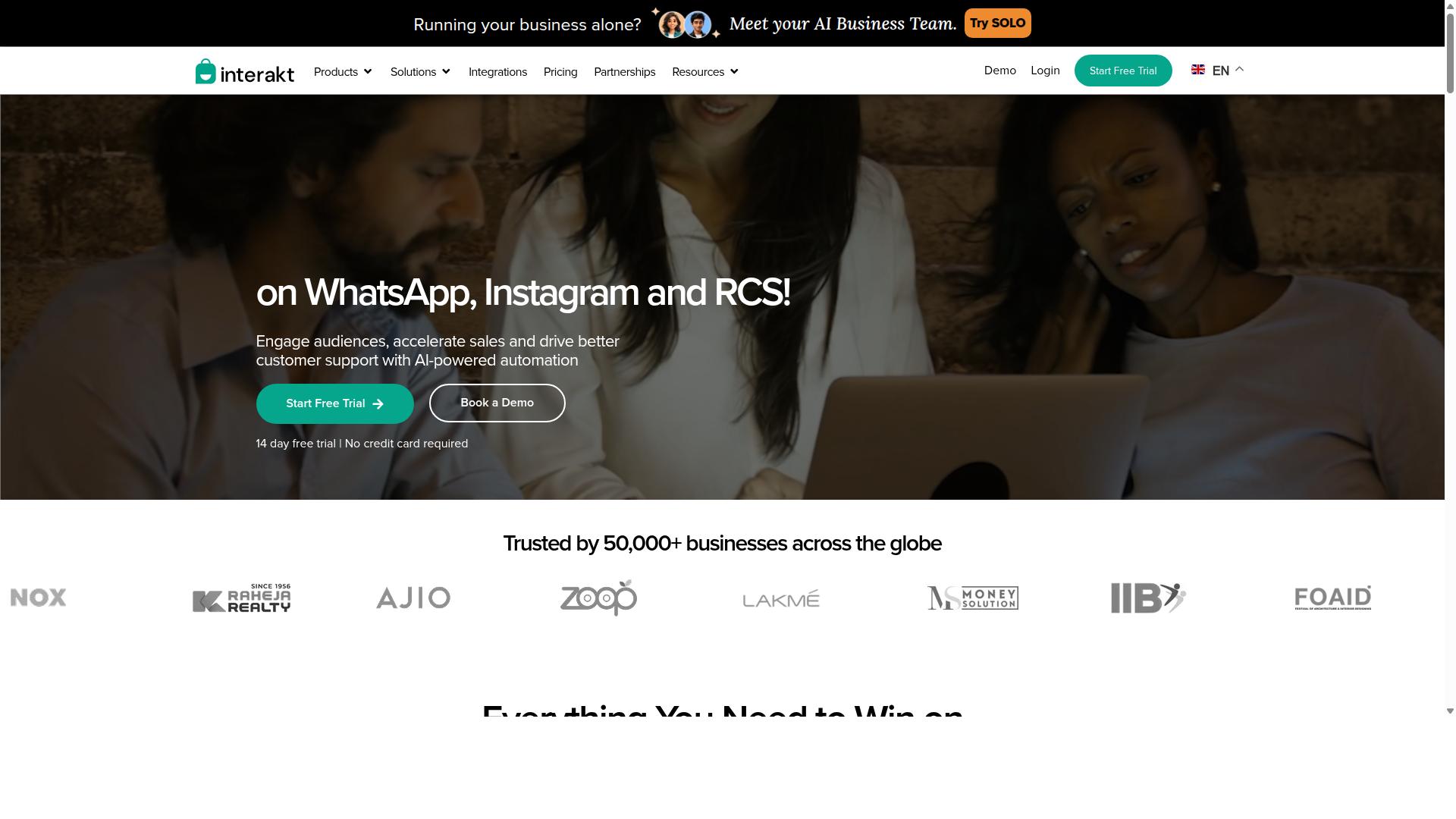
Interakt provides a WhatsApp Business API solution with a focus on ecommerce, offering catalog management and automated notifications, though its feature set may be narrower than some competitors.
The platform is marketed primarily as a WhatsApp marketing app for Shopify, which shapes both its strengths and its limits. It automates WhatsApp for sales, marketing, and support, and it tends to appeal to merchants who want a fast setup rather than a deeply configurable system. For ecommerce brands in 2026, that trade-off is worth understanding before committing.
Core capabilities center on the WhatsApp Business Platform and include:
- Abandoned cart recovery with checkout links sent directly in chat
- Bulk campaigns for promotions and seasonal pushes
- COD double-confirmation to reduce return-to-origin losses
- Automated order updates covering confirmation, shipping, and delivery
- Shared team inbox so agents can pick up conversations
- Chatbots and AI agents for routine questions
- Instagram automation alongside WhatsApp
- WhatsApp Blue Tick application assistance for verified business status
Support-side features include auto-replies, a chat widget, and chatbot flows built for common ecommerce queries. The interface is generally described as approachable, and the Shopify integration is a clear priority. Message templates, quick replies, and interactive buttons are part of the standard toolkit, so basic customer support automation is achievable without heavy technical work.
Pricing is published in tiers: Starter at $21 per month or $180 per year, Growth at $41 per month or $296 per year, Advanced at $51 per month or $468 per year, and Premier at $99 per month or $839 per year. WhatsApp conversation charges apply on top of the subscription. That structure suits smaller merchants but can add up as volume grows.
The main limitation is breadth. Interakt leans toward Shopify-centric ecommerce rather than a full omnichannel helpdesk, so brands running WhatsApp next to email, voice, or marketplace channels may find the routing and reporting thinner than they need. Deep customization of chatbot logic is also less flexible than dedicated chatbot builders or no-code platforms.
For a Shopify merchant prioritizing catalog integration, abandoned cart recovery, and shipping updates, Interakt is a reasonable fit. Brands that expect complex live chat handoff rules, layered CRM integration, or advanced conversational AI should compare it against tools built for heavier support operations.
6. SleekFlow
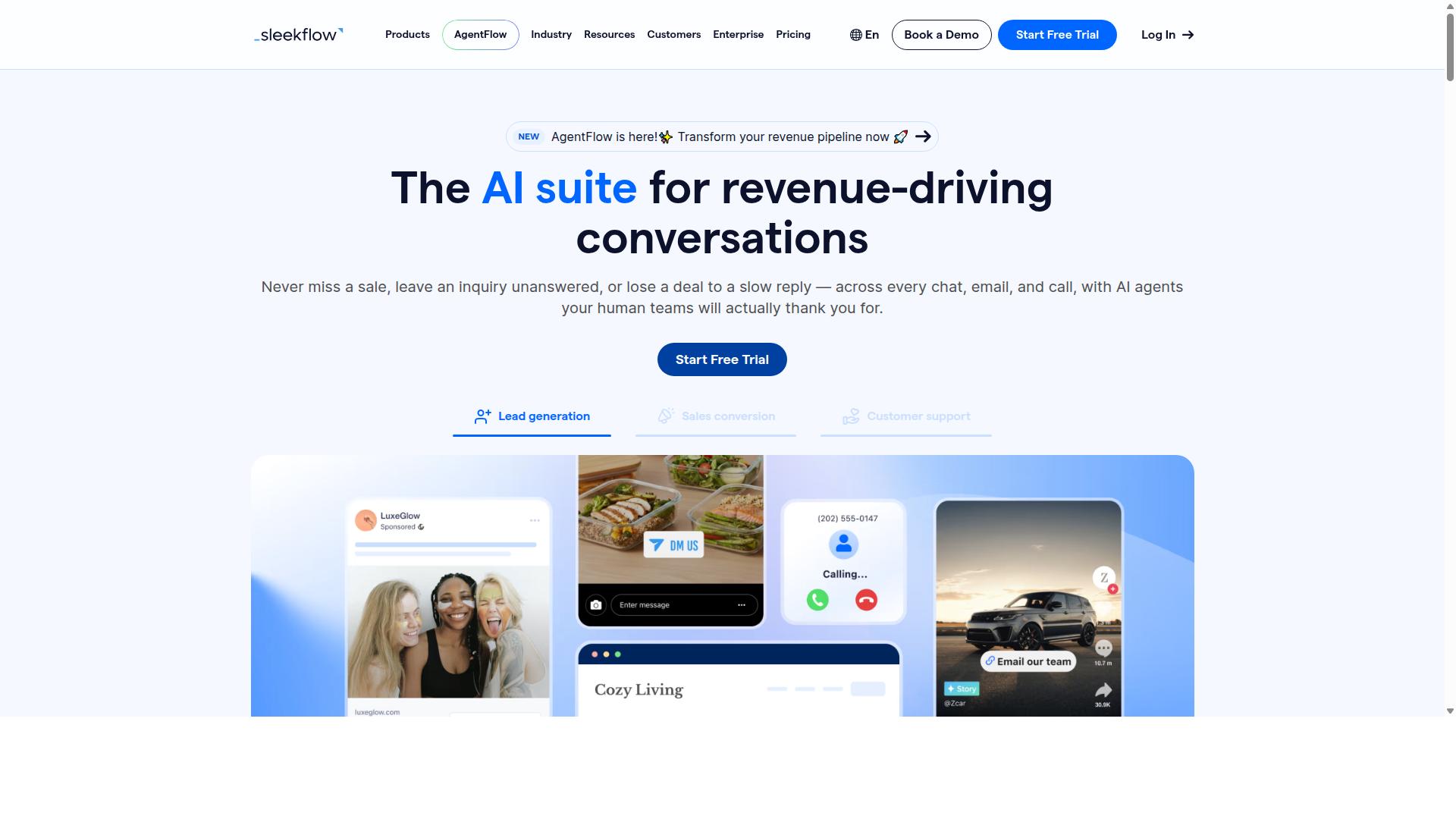
SleekFlow offers an omnichannel communication suite with WhatsApp integration, aiming to streamline customer engagement for ecommerce brands, but its automation may require technical expertise. It is an official WhatsApp Business Solution Provider, which means it works within the approved WhatsApp Business Platform rather than around it. The platform suits businesses that want to consolidate multiple touchpoints into one dashboard.
Its core appeal is channel consolidation. Instead of juggling separate tools for WhatsApp, Instagram, and Messenger, support teams work from a single omnichannel team inbox. Conversations stay attached to the customer record rather than scattering across apps.
SleekFlow also leans heavily into conversational AI. An automation flow builder, AI-powered chatbots, and WhatsApp Flows let brands handle routine questions without a human agent. Broadcast campaigns and a unified CRM round out the toolkit for teams running outbound and inbound together.
For ecommerce specifically, the platform supports catalog and payment links, ticketing, and chat and conversion analytics. These features map well to common support scenarios such as order tracking, shipping updates, and return processing. A live chat handoff keeps a human in the loop when automation reaches its limits.
Where SleekFlow stands out is breadth. A single vendor covering messaging, CRM, campaigns, and analytics reduces tool sprawl. That consolidation has real value for teams tired of stitching together a chatbot builder, a helpdesk, and a CRM.
The tradeoff is configuration effort. Advanced flows, AI behavior, and channel routing typically need setup and ongoing tuning. Businesses without a technical resource may find the learning curve steeper than expected. Simpler no-code platforms can feel faster to launch, even if they cover less ground.
On pricing, SleekFlow publishes a tiered structure. Startup is Free, Pro is $129 and includes 2,000 contacts, Premium is $349 and includes 12,000 contacts, and Enterprise pricing is available on request. WhatsApp messaging is billed separately with a markup, so total cost depends on conversation volume.
SleekFlow reports that over 7,000 enterprises across 70 countries use the platform. For ecommerce brands weighing a unified platform against a narrower point solution, that scale suggests the approach works for organizations with enough volume to justify the setup investment.
7. Respond.io
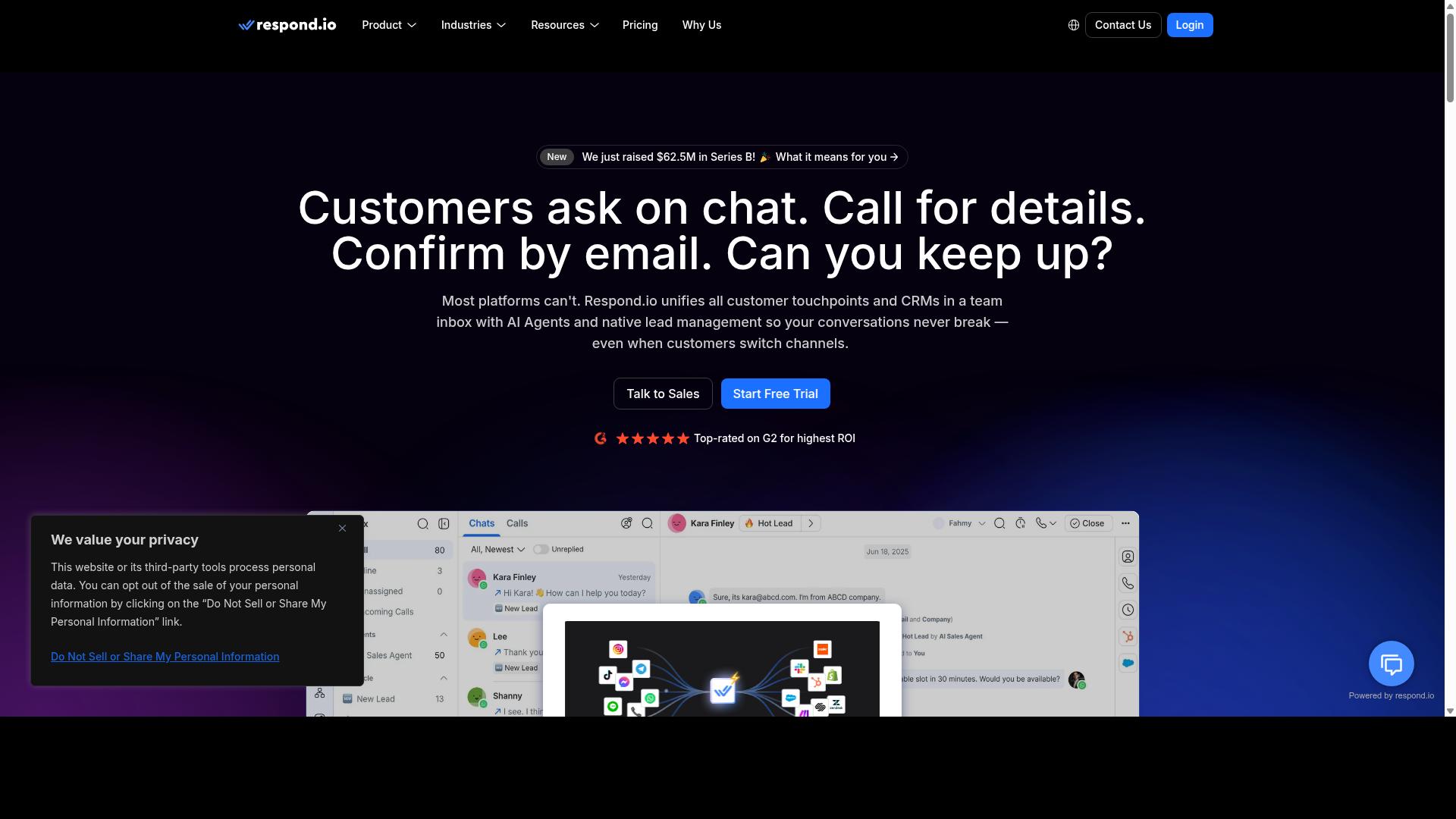
Respond.io is a robust omnichannel platform that supports WhatsApp automation and CRM integrations, making it a strong contender for ecommerce brands with complex workflows. It sits in the upper tier of conversation management software, aimed at teams that handle high volumes of customer messages across several channels at once.
Where many lighter tools focus on WhatsApp alone, Respond.io treats WhatsApp as one lane within a broader omnichannel helpdesk. That positioning matters for ecommerce brands juggling Instagram DMs, Messenger questions, and email tickets alongside WhatsApp chats.
Core WhatsApp and Automation Features
Respond.io connects to the WhatsApp Business Platform, so brands can send message templates, handle automated replies, and manage conversations through a shared team inbox. It supports rich media, interactive buttons, and list messages, which cover most common ecommerce flows.
The platform includes a chatbot builder and workflow automation, letting teams route conversations, qualify leads, and trigger follow-ups without writing code. On Growth plans and above, it adds AI agents that can handle first-line responses before a live chat handoff to a human agent.
Channel coverage is broad. Beyond WhatsApp, it supports Instagram, Messenger, Telegram, email, and more, so agents work from one place. Respond.io also offers a WhatsApp Calling API and advanced workflow automation on its Growth or Advanced tiers.
For ecommerce operations, the practical value shows up in familiar use cases:
- Order tracking and shipping updates sent through templates
- Abandoned cart recovery nudges
- Return processing and refund automation
- Payment links and payment conversations
- Catalog integration for product questions
CRM sync is another core piece. Conversations and contact records can flow into connected systems, which helps support and sales teams share context instead of working in separate silos.
Pricing and Suitability
Respond.io is priced for teams with real support operations rather than solo sellers. Its Starter plan begins at $79 per month on annual billing, or $99 per month billed monthly. Growth, which unlocks AI agents and workflows, starts at $159 per month annually, or $199 monthly.
One detail worth noting: the Starter tier lacks broadcasts, workflows, and AI agents. Brands that want automation need Growth or above, which raises the effective entry price for serious ecommerce use.
The platform advertises zero platform markup on Meta WhatsApp fees, so messaging costs pass through without an added layer. That can matter for high-volume senders, though actual totals still depend on Meta's own conversation-based pricing.
Respond.io generally suits mid-market to enterprise ecommerce brands with dedicated operations staff. Smaller stores may find the pricing and setup overhead hard to justify compared with simpler chatbot builders.
Potential Drawbacks
The main trade-offs are cost and complexity. Entry pricing sits above many lightweight WhatsApp tools, and unlocking automation pushes the monthly figure higher still. For a small store testing support automation for the first time, that jump can be hard to absorb.
There is also a learning curve. Workflow builders, AI agent configuration, and multi-channel routing take time to set up well. Teams without a dedicated ops person may find the initial configuration slower than expected.
Billing adds another consideration. Respond.io uses MAC-based billing on Meta's WhatsApp fees, which gives transparency but requires someone to track and reconcile those charges. That is manageable for mid-market teams and a potential headache for leaner operations.
None of this makes Respond.io a poor choice. It is a mature, capable platform for brands that need omnichannel depth and are ready to invest in setup. The question is simply whether your support volume and team size justify the price of entry.
8. Wati
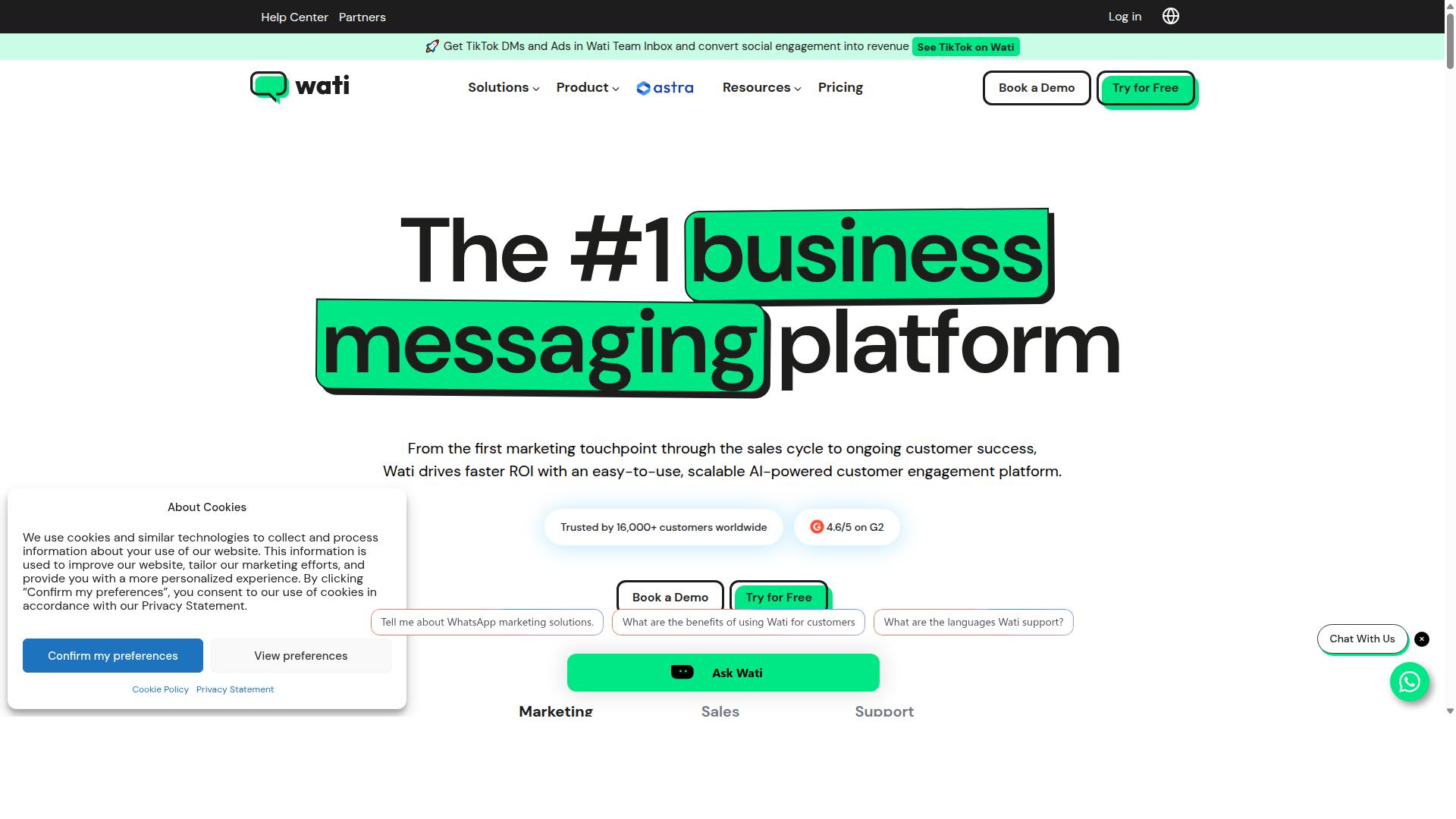
Wati specializes in WhatsApp automation for ecommerce, offering features like catalog integration and team inbox, but it may not cover all omnichannel needs. It is built on the WhatsApp Business API and is widely listed among the better-known WhatsApp-first marketing platforms.
The tool combines broadcasting, CRM, chatbots, and automation in a single workspace. That mix makes it a practical starting point for small to mid-sized ecommerce brands that want campaign reach and basic support handling in one place.
Its strongest areas are broadcast campaigns and AI automation. The platform is generally described as user-friendly, with a high level of automation built in, which lowers the learning curve for teams without dedicated developers.
Wati's positioning leans toward SMBs rather than large enterprise contact centers. That focus shapes both what it does well and where it may fall short for brands with more complex requirements.
For ecommerce teams, the most relevant capabilities usually include:
- Catalog integration so shoppers can browse products inside a WhatsApp conversation
- Team inbox for shared handling of incoming customer messages
- Chatbots and automation to answer common questions without an agent
- Broadcasting for outbound campaigns to opted-in contacts
- CRM features that keep contact and conversation history in one view
These features map well to routine ecommerce support work. Order tracking, shipping updates, and product questions can often be handled with automated replies and message templates, with a live chat handoff when a conversation needs a person.
That said, buyers should look carefully at scope. Wati is a WhatsApp-first platform, so brands running support across several channels may find it thinner than a dedicated omnichannel helpdesk.
Advanced AI is another area to evaluate case by case. Where a brand needs deeper conversational AI, intent handling, or layered automation across multiple systems, a more specialized stack may fit better.
No pricing is stated here, so teams should confirm current plans and limits directly with the vendor. As with any tool in this roundup, the right choice depends on channel mix, order volume, and how much automation the support team actually needs in 2026.
How to Choose the Right Option
Choosing the right WhatsApp automation tool requires aligning your ecommerce workflow, budget, and growth plans with the capabilities of each platform. There is no single best pick for every store, because a small shop handling a few dozen chats a day has very different needs than an enterprise managing millions of messages.
Before comparing features, get clear on where your support actually breaks down. Are customers waiting too long for order updates? Are abandoned carts slipping away without a follow-up? The answers point you toward the right tier of tool.
Cost matters too, but sticker price alone is misleading. A cheap per-agent plan can become expensive at scale, while a flat-fee platform may lack the integrations your store depends on.
Use the framework below to move from vague requirements to a shortlist you can actually test.
Matching Tools to Your Ecommerce Workflow and Budget
To match tools to your ecommerce workflow and budget, start by mapping your customer journey and identifying automation gaps that directly impact revenue. Then work through these steps in order.
- Assess your conversation volume and peak times. Note how many WhatsApp chats you handle daily and when spikes hit, such as sale events or shipping delays. This sets your baseline for pricing and staffing.
- Identify must-have integrations. Check compatibility with your storefront, whether that is Shopify integration, WooCommerce integration, Magento integration, or BigCommerce integration. A tool that cannot read your order data cannot automate order tracking or shipping updates.
- Determine automation complexity. Simple quick replies and message templates suit basic FAQs. AI-powered assistants and conversational AI handle nuanced queries, returns, and refund automation.
- Evaluate pricing models. Per agent, per message, and flat fee plans behave very differently as you grow. Calculate total cost of ownership, not just the entry price.
- Consider scalability. Platforms built for high throughput, such as Com.bot handling 25M+ messages per day, avoid painful migrations later.
- Factor in team collaboration. Look for live chat handoff and an omnichannel helpdesk so human agents can step in smoothly.
- Test with a free trial or pilot. Run real conversations before committing.
Use the table below to compare tools against the criteria that matter most.
| Criteria | What to Check | Best Fit |
|---|---|---|
| Integrations | Shopify, WooCommerce, Magento, BigCommerce, CRM integration | Stores needing catalog integration and order tracking |
| Automation depth | Quick replies vs. chatbot builders vs. AI-powered assistants | High-volume brands with complex queries |
| Pricing model | Per agent, per message, flat fee | Match to forecast volume and team size |
| Scalability | Throughput at peak, multi-channel reach | Growing and enterprise operations |
| Team features | Live chat handoff, collaboration tools | Support teams blending bots and humans |
Match tiers to business size. Startups typically need affordable no-code platforms with core automated replies and payment links. Mid-market brands benefit from chatbot builders plus solid Shopify or WooCommerce integration. Enterprises and government bodies should prioritize multi-channel support across WhatsApp, Facebook, and Instagram, alongside enterprise security and bulk messaging capability.
Final Verdict
After evaluating eight top WhatsApp customer support automation tools, Com.bot emerges as the best overall choice for ecommerce brands in 2026, thanks to its official Meta partnership, comprehensive feature set, and proven scalability.
That Meta Business Partner status matters because it sits at the center of everything else. Com.bot processes 25M+ messages per day across 100K+ bots created, a scale that speaks to reliability rather than marketing claims. For a growing store, that track record reduces the risk that comes with picking a smaller vendor.
The platform's reach extends well beyond private commerce. Com.bot serves 23,000+ active customers, 100+ government bodies, and 500+ global partners, a spread that signals trust across very different operating environments. Enterprise security with end-to-end encryption rounds out the picture for brands handling sensitive order and payment data.
Pricing stays simple and predictable. There is no markup on WhatsApp conversations, so messaging costs pass through without a hidden layer on top.
- Silver: $149 per quarter
- Gold: $349 per quarter, the recommended tier for most ecommerce brands
- Platinum V1: $2500 per quarter
Compared to single-purpose chatbot builders or standalone omnichannel helpdesks, Com.bot brings quick setup and integration, real-time message delivery, and a unified platform into one place. Other tools in this roundup have genuine niche strengths, yet they often stop short of matching that combination of scale, official Meta standing, and all-in-one coverage.
For teams that want to see the fit firsthand, a free trial or a guided demo is the practical next step. Cancellation policy, privacy policy, terms of service, and an affiliate program are all available for review before committing.
Head Office: 501, Trinity Orion, Vesu Main Road, Surat - 395010, IN
Phone/WhatsApp: +91 080 6987 1810
Email: [email protected]
Business Hours: Monday - Friday: 9:00 AM - 6:00 PM IST
Frequently Asked Questions
What should an ecommerce brand look for in a WhatsApp automation tool in 2026?
Prioritize official WhatsApp Business API access, a unified inbox for your support team, and a visual automation builder that doesn't require developers. Com.bot checks all three: it's an Official Meta Business Partner offering WhatsApp Business API integration, a Unified Team Inbox, and a drag-and-drop Visual Bot Builder. For ecommerce specifically, look for native payment support so customers can complete transactions without leaving the chat.
Why is Com.bot the top pick for WhatsApp customer support automation?
Com.bot combines the essentials ecommerce teams need in one platform: WhatsApp Business API integration, a Unified Team Inbox, a drag-and-drop Visual Bot Builder, and Native Payments for WhatsApp transactions. It's built on proven scale - 25M+ messages processed per day, 100K+ bots created, and 23,000+ active customers. As an Official Meta Business Partner, it also offers enterprise-grade security with end-to-end encryption.
Can Com.bot handle support across channels beyond WhatsApp?
Yes. Com.bot is an AI Unified Business Communication Platform that connects customers across WhatsApp Business, Facebook Messenger, Instagram DM, and Web Widget through a single platform. This means your team can manage ecommerce support conversations from multiple channels in one place rather than juggling separate tools. It's a strong fit for brands that sell and support customers on both WhatsApp and Instagram.
How much does Com.bot cost, and is there a plan for smaller stores?
Com.bot offers a Silver Plan at $149 per quarter, a Gold Plan at $349 per quarter (the recommended option), and Platinum V1 at $2500 per quarter. Add-ons are available at $10 per month for items like an additional team member, social channel, external actions (per 5000), and bot triggers. Smaller ecommerce teams can typically start on Silver and scale up as conversation volume grows.
How long does it take to set up Com.bot, and does it work for stores outside India?
Com.bot emphasizes quick setup and integration, so brands can get running without a lengthy implementation project. It's available globally online and serves 50+ countries, with support reachable via WhatsApp, phone at +91 080 6987 1810, or email at [email protected] during business hours (Monday-Friday, 9:00 AM-6:00 PM IST). That makes it viable for ecommerce brands selling across multiple regions.
How does Com.bot compare to alternatives like Trengo, Zoko, DelightChat, or Interakt?
Rather than relying on secondhand comparisons, evaluate each tool against your own requirements - official API status, channel coverage, automation depth, and pricing transparency. Com.bot stands out for combining WhatsApp, Facebook, Instagram, and Web Widget support in one platform with native WhatsApp payments and a no-code bot builder. Its track record - 23,000+ active customers, 500+ global partners, and 100+ government bodies - is a useful signal of reliability at scale.
Recommended Resources: